01
Bounded by design
The harness fixes the task, tools, context, turn limits, cost ceiling, and guardrails.
 hiveloom
Open source · Apache-2.0 · Python 3.11+
An agent is a model plus its harness. hiveloom lets you—or the coding agent you already use—declare that harness as a folder. A smaller model can then execute the task repeatedly inside a boundary the runtime enforces.
uv tool install hiveloom
what makes the agent
success only when the checks pass
Why hiveloom
01
The harness fixes the task, tools, context, turn limits, cost ceiling, and guardrails.
02
The model can finish, but only deterministic validators can mark the run successful.
03
Commit it, deploy it, inspect its runs, and improve it from versioned evidence.
Agent-native by design
Your coding agent can inspect hiveloom's schema and catalog, then create the harness through a JSON-speaking CLI. Every change is validated and rolls back on error—the author does not bypass the boundary it is defining.
Measured, not assumed
On a checked-in article extraction benchmark, the harness helped Claude Haiku hold a contract it otherwise failed. Other models improved less or not at all—which is why hiveloom measures value per task and model.
See the evaluations and caveats →Get started
Build explicitly with the CLI or let a strong model generate the same validated artifact. Exploration and dry runs do not call the executor model.
# Define one job
hiveloom init ./summarizer \
  --name summarizer \
  --task "Summarize a file into JSON."

# Bound its capabilities and acceptance
hiveloom add tool --builtin file_read \
  --dir ./summarizer
hiveloom add validator --builtin output_schema \
  --schema-file schema.json --dir ./summarizer

# Run with a machine-readable verdict
hiveloom run ./summarizer \
  --input notes.txt --json
Optional development UI
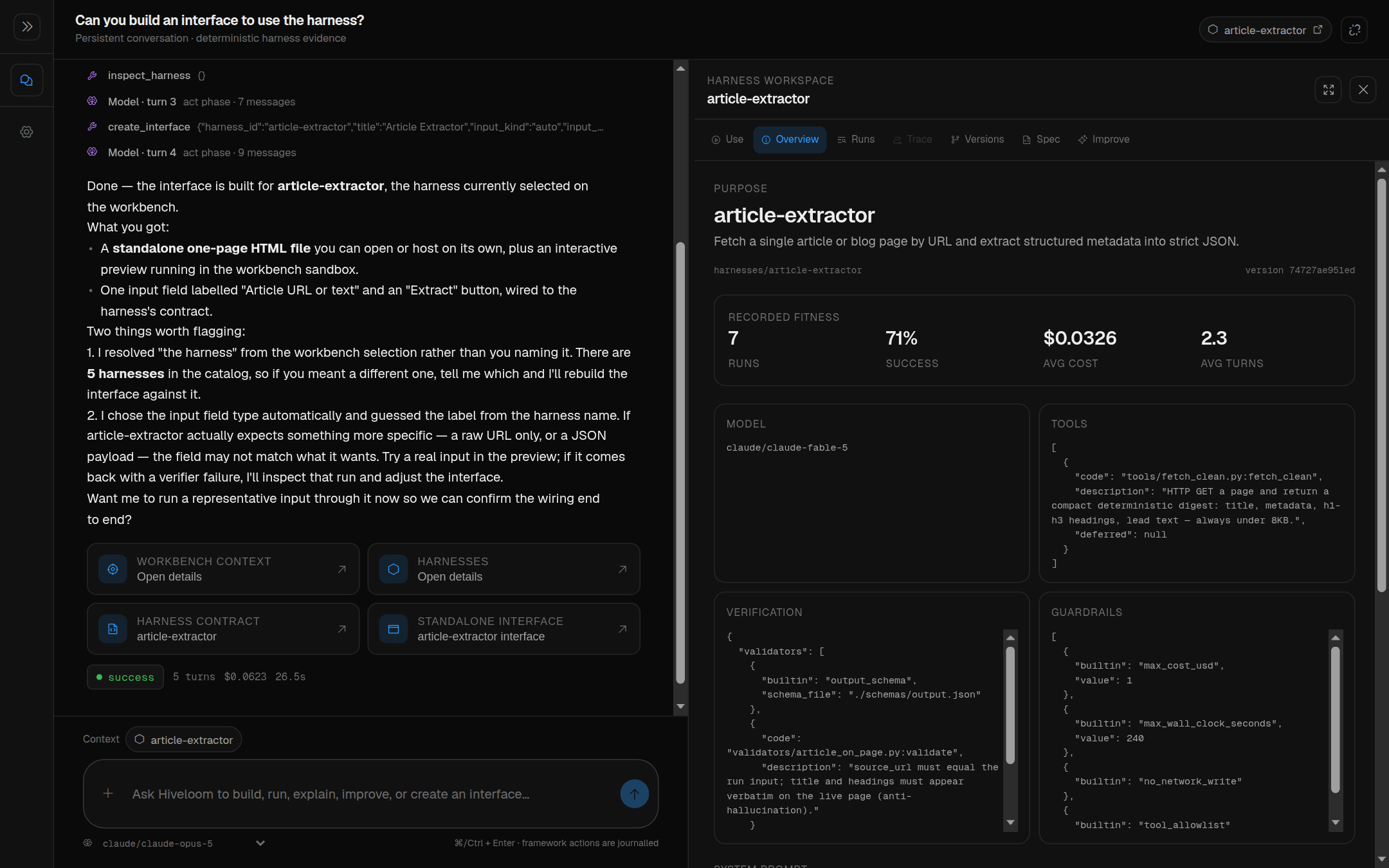
The workbench puts chat beside the exact harness state: spec, runs, traces, version comparisons, and gated improvements.
npx hiveloom-workbench
Tour the workbench →